





Pre-colonial images of Old Singapore frequently include wooden kampongs, sampans, and jetties, a tribute to the city’s humble beginnings as a fishing hamlet. During British colonial rule, brick and concrete structures were introduced, resulting in some of the country’s most iconic buildings still standing today despite Modern Singapore’s continual evolution.
Here are the buildings that have survived for over a century.
Armenian Church
The first Christian church in Singapore built in the early nineteenth century along Hill Street. Not only that, but it was also the first building in Singapore to have electricity in 1909. It was commissioned by the first twelve Armenian families who settled on the island and created by famed Irish architect George D. Coleman. It is dedicated to St Gregory the Illuminator, the first Armenian monk. The small church which was designated as a national monument in 1973 and restored in 1994, also serves as a memorial to Singapore’s once-powerful Armenian community which included the Sarkies brothers who built the Raffles Hotel, Agnes Joaquim, who hybridized Singapore’s national flower Vanda ‘Miss Joaquim,’ and Catchick Moses, who co-founded the national newspaper The Straits Times.
Central Fire Station
The red and white exterior of the Central Fire Station is easily recognisable. It also has a watchtower and firefighter housing quarters, and it was used to track firefighting and civil defence advancements throughout Singapore.
Today, the Central Defence Heritage Gallery serves as a civil defence museum. It welcomes anyone to fully experience and comprehend this vital aspect of Singapore’s history with fire engines and equipment on display as well as unique interactive stations for a close-up view of what firemen and rescuers go through during a mission.
Lau Pa Sat

Lau Pa Sat, one of Singapore’s most prominent hawker centres is a sensory overload featuring everything from local to foreign cuisine. But chances are, you did not realize it began as a fish market on the riverfront in 1824 before moving to its current location in 1894.
Lau Pa Sat with its characteristic octagonal shape and decorative columns is one of Southeast Asia’s oldest Victorian constructions and one of Asia’s first prefabricated cast iron structures. Despite repeated transformations, the market maintains its original vision and beautiful old-world charm. In 1973, it was designated as a national monument and making it a well-known Singapore landmark.
Malay Heritage Centre
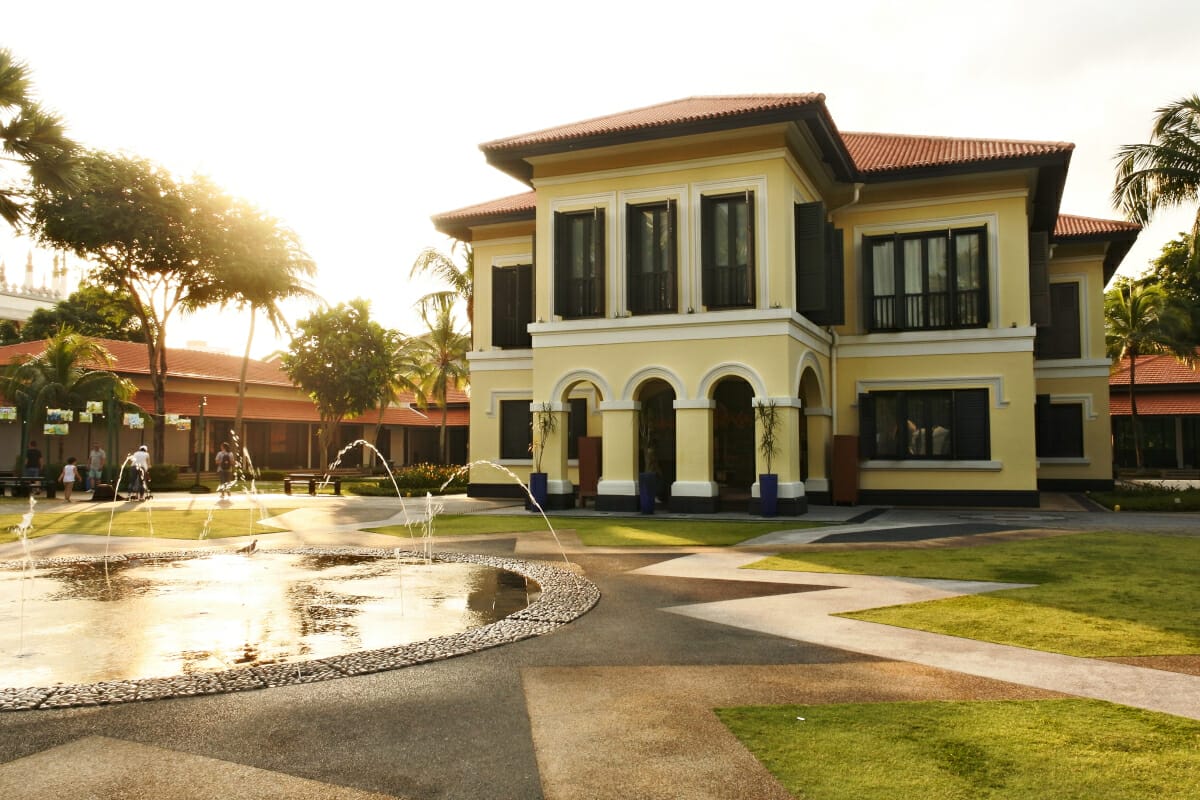
Since its completion in 1843, the magnificent structure, formerly known as Istana Kampong Glam has been home to Malay royalty and the capital of the sultanate. The palace that was also designed by George D. Coleman combines the Palladian style, which was prominent in England at the time with traditional Malay elements. When Singapore gained independence in 1965, the Kampong Glam estate including the Istana became state land.
In the late 1990s, the government announced plans to convert the former Istana into a Malay Heritage Centre, highlighting the Malay community’s rich arts and cultural traditions. The centre has honoured Malay culture with five permanent galleries, family-friendly festivals, and interesting programs since it first opened its doors in 2005. In 2015, it has been declared a national monument.
Sri Mariamman Temple

Surprisingly, Singapore’s largest and oldest Hindu temple is located in the heart of Chinatown. The Sri Mariamman Temple began as a simple shelter made of wood and attap in 1827, when it was established by Naraina Pillai, the first recorded Indian immigrant to colonial Singapore. It was named a national monument in 1973 and is dedicated to Mariamman, the Goddess of Rain.
The oldest bricks in the current construction originate from 1843. It is known for its incredibly detailed tower entrance. Theemidhi, a spectacular fire-walking ceremony celebrated a week before the Hindu festival Deepavali, is also held there.